Rechnungsabgleich_ Sicherheit bei der Freigabe

Why invoice matching is essential for secure approvals

Norman Rohr, CEO finway
  • Norman Rohr
  • 18.03.26
  • 5 min read

Many mid-sized enterprises face a familiar and frustrating challenge: deliveries arrive, invoices follow, but nobody knows for sure if the received goods exactly match the original purchase order. When managing directors and finance leaders approve these invoices, they often rely on gut feeling or incomplete spreadsheets. This approach inevitably leads to incorrect bookings, unnoticed overdeliveries, and a massive loss of financial control.

This post explores why the precise matching of purchase orders, delivery notes, and invoices forms the absolute foundation of secure financial management. You will discover how missing checks lead to hidden costs and how modern processes can revolutionize your company’s daily operations. By the end, you will understand exactly how to build transparency while conserving your most valuable resources.

The danger of lacking control in goods receipt

A seamless workflow between procurement, goods receipt, and accounting is critical for a company’s liquidity. When supply chain managers or procurement heads lose track of incoming goods, the entire value chain suffers. Partial deliveries, mixed deliveries, or damaged goods often remain completely unnoticed until the invoice has already been paid.

This creates significant financial risks, especially in companies handling a high volume of purchase orders. The accounting department receives invoices for payment but cannot verify if the billed items are actually sitting in the warehouse. Operating in the dark like this costs money and wastes enormous amounts of time. Employees spend hours trying to resolve discrepancies long after the fact.

A real-world example: A Stuttgart construction company

A Stuttgart-based construction company perfectly illustrates how quickly control can slip away. The business regularly orders materials and parts for various large-scale construction projects. Deliveries arrive at multiple locations, split between active construction sites and their main central warehouse.

The commercial directors faced an enormous challenge: the company was simply unable to check whether the delivered items had actually been ordered. They completely lacked a system to verify receipts against purchase orders. If important parts were missing, the team only realized it on the construction site, causing expensive project delays. If there was an overdelivery, employees simply put the excess materials into the warehouse. The company then unknowingly paid for unneeded stock. This practice caused highly unnecessary expenses and created a chaotic inventory system.

The vital link between supply chain and accounting

The supply chain manager bears the responsibility for an efficient flow of materials. They need reliable data to evaluate suppliers properly and prevent bottlenecks. The accounting department, on the other hand, needs absolute certainty that invoices are factually correct before they release any payments.

An information gap opens up whenever purchase orders and delivery notes fail to match perfectly. Spreadsheet-based PO management reaches its limits very quickly in these scenarios. Spreadsheets are highly prone to errors, rarely up to date, and offer no real foundation for cross-departmental collaboration. To guarantee security during invoice approval, the systems used by procurement, warehousing, and finance must communicate seamlessly with one another.

How finway solves the matching problem

finway tackles these exact challenges by addressing the root cause of the problem. We replace manual paperwork and messy spreadsheets with an intelligent, automated process. This workflow ensures your team never pays an invoice unless the underlying delivery is flawlessly verified.

Automatic matching at the line-item level

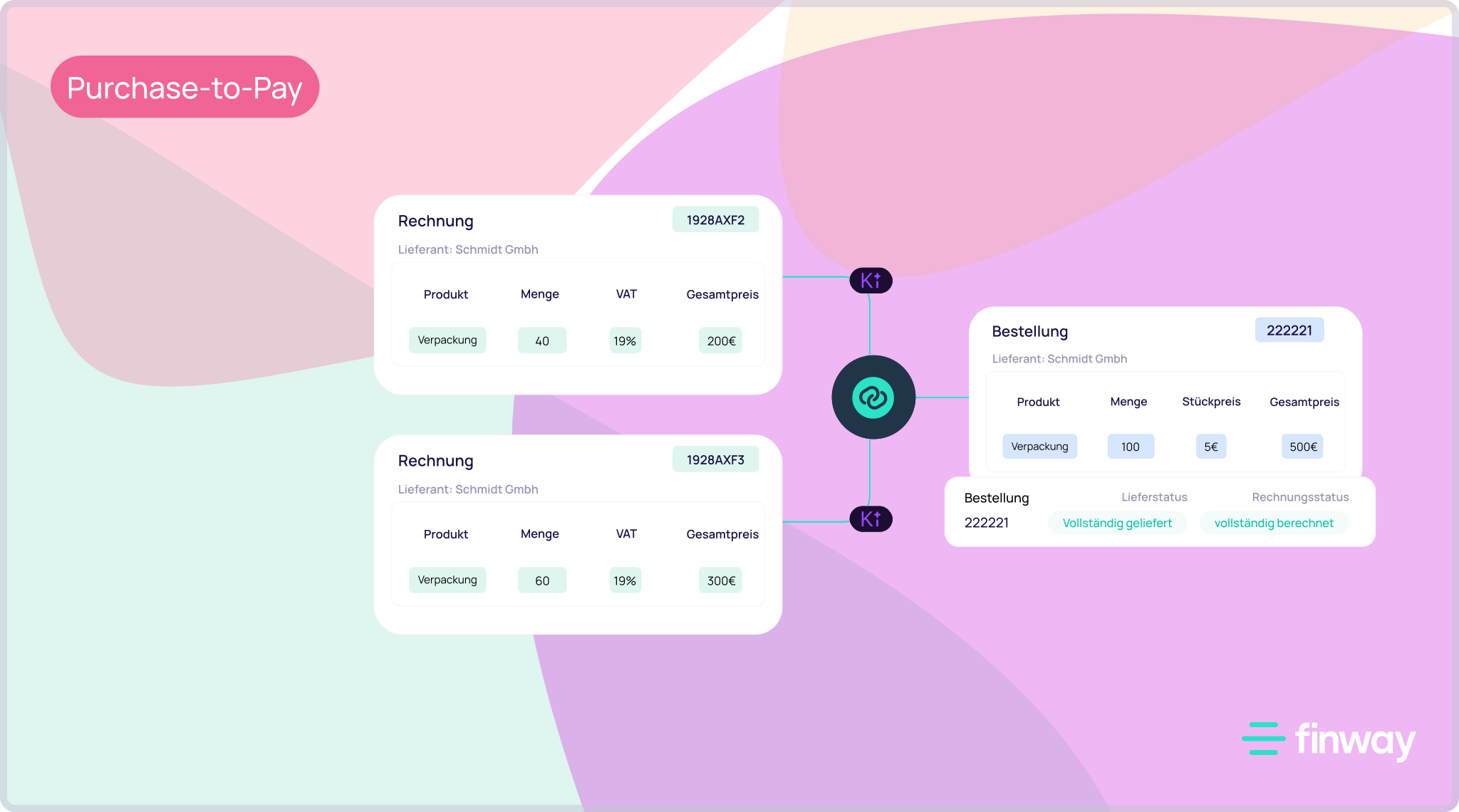
With finway, you simply scan your delivery notes into the system. The platform automatically matches these documents against the original purchase orders right down to the line-item level. Your team in the warehouse or on the construction site can easily annotate specific line items digitally. They can add comments like “incorrect delivery,” “broken item,” or “bad quality” with just a few clicks.

The purchase orders in the system update automatically to reflect the exact delivery status. The platform immediately flags any missing items, allowing procurement to react promptly and request replacements. Overdeliveries no longer disappear unnoticed into the warehouse; instead, they are immediately disputed or correctly recorded in the books.

Total transparency across all departments

This digital matching process keeps all involved teams constantly in the loop. The accounting department sees instantly whether they can approve an invoice or if there are unresolved delivery discrepancies. The supply chain manager maintains full, real-time visibility over outstanding orders and supplier reliability.

The measurable impact: Time savings and security

Implementing a systematic invoice and delivery matching process protects your company from unjustified expenses. You only pay for what you actually ordered and received in perfect condition. At the same time, you drastically minimize the risk of project delays caused by missing materials.

The biggest direct benefit lies in a massive boost to efficiency. Experience shows that employees involved in the process save up to 50% of their time through automated matching with finway. The hours spent searching for delivery notes, calling the construction site, and manually typing data disappear entirely. Managing directors and finance heads gain flawless, real-time transparency, empowering them to approve invoices with absolute confidence.

Conclusion and next steps

A reliable matching process between purchase orders, deliveries, and invoices is never just an option; it is an absolute necessity for healthy financial management. Automating this process lowers costs, prevents expensive errors, and noticeably relieves the burden on your team.

Take a moment to evaluate your current workflows for goods receipt and invoice approval. Identify your operational weak points and explore where automation can make an immediate impact. By using intelligent solutions to bridge the data gaps between procurement, the warehouse, and accounting, you build a solid foundation for secure growth.