Beschaffungsprozesse

Agile and controlled: How to Successfully Structure Your Procurement Processes

Norman Rohr, CEO finway
  • Norman Rohr
  • 29.01.26
  • 6 min read

Balancing necessary control with operational speed is one of the biggest challenges in financial management for medium-sized businesses. Too much bureaucracy paralyzes the ability of specialized departments to act; too little control endangers liquidity and compliance.

Especially in times of economic tension, one principle applies more than ever: every euro counts. But saving doesn’t mean slowing down processes with complex application forms. It means creating intelligent structures that allow agility where it’s needed and enforce control where it’s critical.

As a provider of all-in-one software for spend management, at finway we see ourselves not just as a technology supplier, but as a partner on equal footing. Even more so: We are our own “super user.” We use our software daily to scale our own processes. In this article, we share our internal best practices and show you what a modern procurement structure looks like in practice—far removed from theoretical models.

The “Dog Food” Principle: How We Manage Our Expenses at finway

We firmly believe that you can only recommend what you successfully use yourself (“eating our own dog food”). Our internal finance processes are set up to be maximally efficient without our accounting team losing control.

We strictly distinguish by the type of expense. For each expense type, we have defined a specific workflow that offers exactly the right balance of freedom and oversight.

1. Small Amounts and Daily Needs

No one wants to fill out a three-page application for a pack of coffee or fresh fruit for the office. This frustrates employees and ties up expensive working time in the finance team.

Our approach:
Our department heads and office management have physical or virtual corporate cards with a deliberately low monthly limit (e.g., 250 – 500 EUR). Within this limit, they can act autonomously.

  • The process: The purchase is made, the receipt is uploaded via the mobile app—done.
  • The control: Thanks to our workflow engine, we have set up an “auto-approver” for small amounts. Only when an amount exceeds, for example, 100 EUR does the approval workflow kick in, requiring the manager to approve digitally. This creates trust and speed with minimal risk.

2. Mid-Sized One-Off Purchases

A typical scenario from our customer onboarding calls: “But what if one of our locations suddenly needs a new refrigerator?”

Our approach:

Here, we do not recommend blanket limits, but rather purpose-bound one-time cards.

  • The practical example: If the refrigerator costs 800 EUR, the employee creates a purchase request for exactly this amount.
  • The solution: After digital approval, a virtual card is generated that has a limit of exactly 800 EUR and is valid only for this purpose. After the transaction, the card can be closed. There is no paperwork, no out-of-pocket expenses for employees, and full transparency regarding what the budget was used for.

3. Large Investments and Strategic Procurement

When it comes to new framework agreements with service providers, booking a trade fair booth, or purchasing raw materials, the requirements change. Here, compliance and budget adherence are paramount.

Our approach:

For these items, we use our “Purchase Order” solution. This allows the finance department to intervene even before the order is placed.

  • The process: Before a legal commitment is made, the request goes through a multi-stage approval process. Here, we check budgets and conditions.
  •  The security: The order is only triggered after approval. This effectively prevents so-called “maverick buying”—uncontrolled purchasing that bypasses the purchasing department.

4. Recurring Costs (Subscription Management)

SaaS tools and subscriptions are cost drivers that often continue unnoticed even though they are no longer used.

Our approach:

We manage all recurring payments through our Subscription Management. Every software license is assigned an owner. If an employee is offboarded or a tool is no longer needed, cancellation or reassignment is immediately on the radar.

The Background Workflow: Approval, Review, and Payment

Intelligently structuring expense types is just the first step. Efficiency comes from automating the downstream steps. At finway, invoices and orders follow a clear path that eliminates sources of error.

Automated Approval

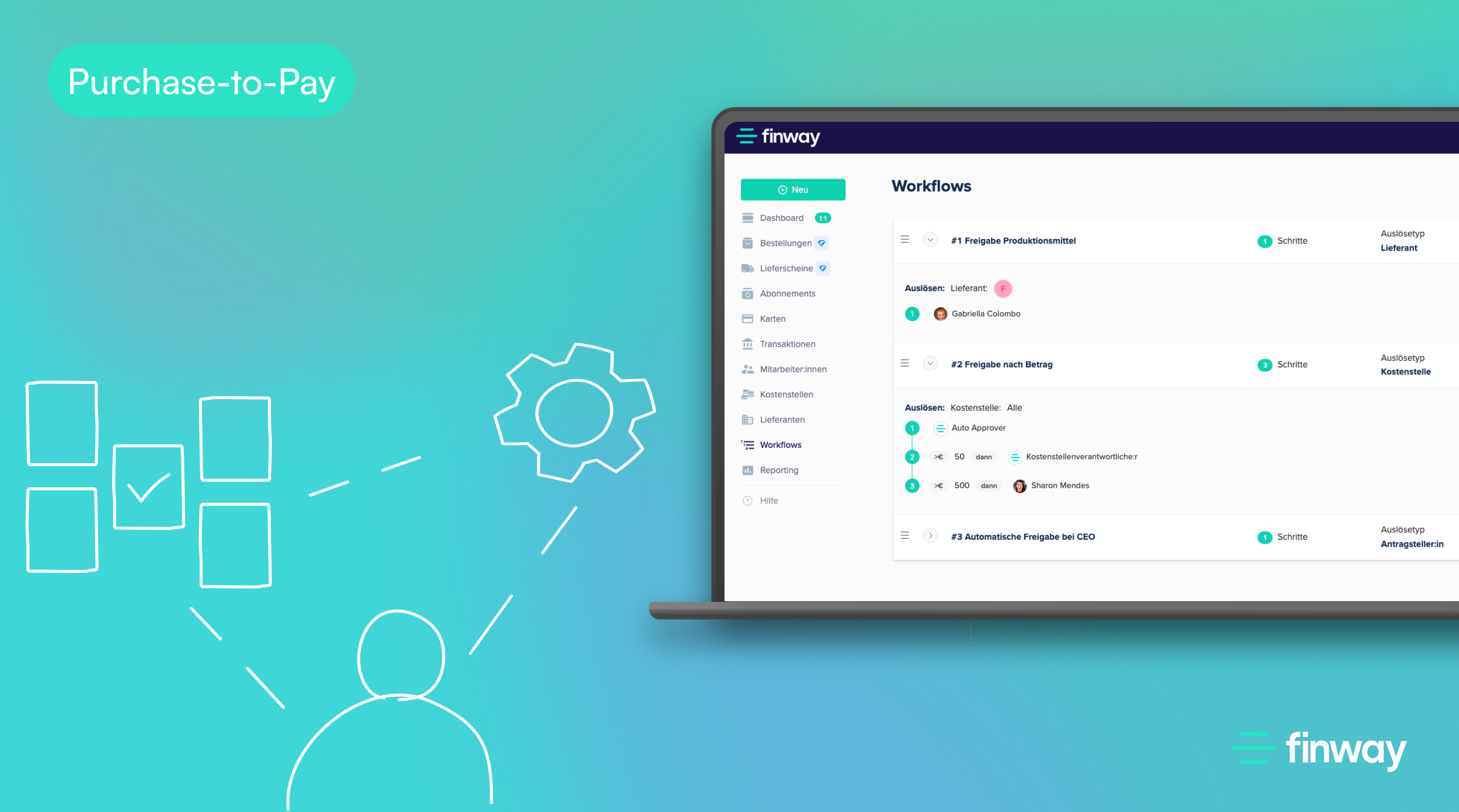
Our workflows are granularly customizable. A rule we use, for example, is: “All invoices from Supplier X are automatically approved unless the net amount exceeds 500 EUR. In this case, Person Y must approve.” This drastically reduces the number of clicks for management, as only exceptions require manual attention.

Technical and Accounting Review

After approval, the process doesn’t end up in a folder but in the “Review” status. Here, our finance team checks the receipt purely from an accounting perspective: Is the tax rate correct? Is the VAT ID correct? Is the cost center pre-assigned correctly? Only after this qualitative check does it proceed.

Seamless Payment and Booking

This is where the circle closes to liquidity.

  1. Matching: If the invoice has already been matched to a card payment, it is automatically marked as “Ready for Export.”
  2. Payment: If payment must be made via bank transfer, this happens directly from finway. Through our bank integration, we synchronize transactions in real-time. A SEPA payment is matched directly with the bank transaction.
  3. Tags: We use custom tags like “international payment” to have maximum transparency in later analyses.

The Impact: Why the Switch Is Worth It

Many managing directors shy away from introducing new software because they fear the implementation effort. However, our experience and our customers’ data show that the opportunity costs of “business as usual” are significantly higher.

Those who digitalize and structure their processes with finway realize measurable competitive advantages:

  • 6% direct cost savings in purchasing: By avoiding double payments, utilizing cash discounts, and preventing unnecessary expenses through pre-approvals.
  • 50% savings in process costs: The time your team spends searching for receipts, manually typing in IBANs, and chasing approvals is halved.
  • 60% relief for accounting: Thanks to pre-assignment and direct export to accounting software (like DATEV), manual booking stacks are eliminated. Your accounting department evolves from data entry clerks to controllers.

Conclusion: Stay “In Control”

A modern finance department doesn’t have to be a bottleneck. By properly differentiating between small expenses and strategic investments, and using software that automatically enforces these rules, you create a culture of responsibility.

You give your employees the tools to work quickly and agilely without ever relinquishing control over liquidity. That is exactly our aspiration at finway: Smart spend management adapted to the realities of medium-sized businesses.

Let’s work together to ensure that every euro in your company is used efficiently.